
ARA's Transformation Gains Steam
The Mindset Value Fund Q2 Investor Letter

Disclaimer: The below post contains the Q2 Investor Letter that I sent to investors in the Mindset Value Fund. This post is NOT a solicitation. I talk about stocks that I own and my view of the future. It is imperative that you do your own due diligence and not rely on anything written below. I’m posting this in order to show how my writing translates to actual performance. With that, I hope you enjoy and gain insights.
The Mindset Value Fund gained 19.2% on a net basis in Q2 and is now flat for the year.
Consorcio Ara Continues to Transform
Consorcio Ara (Mexico: ARA) has continued its strong performance and is now up 40% year to date including dividends. ARA has been the greatest contributor to our performance this year. When a company, especially a microcap is undergoing substantial change there are few eyeballs and few people paying attention, especially if past performance was poor.
ARA used to be considered a value trap. Sure, there was a lot of value, and the company was sitting on a land bank, but the company was under-earning its cost of capital and all that value seemed trapped without any growth, any asset sales, big dividends or substantial buybacks. But for the past 18 months, new management has been transforming this land bank heavy company into a growth engine and cash generating machine.
One excellent example of the sea change in the company is its cash conversion cycle. This is the time it takes for the company to convert assets into cash. Suddenly, last year, deep in the company’s earnings report, ARA started providing investors this information. The data not only gives a clue as to how management thinks about what is important, but its progress.
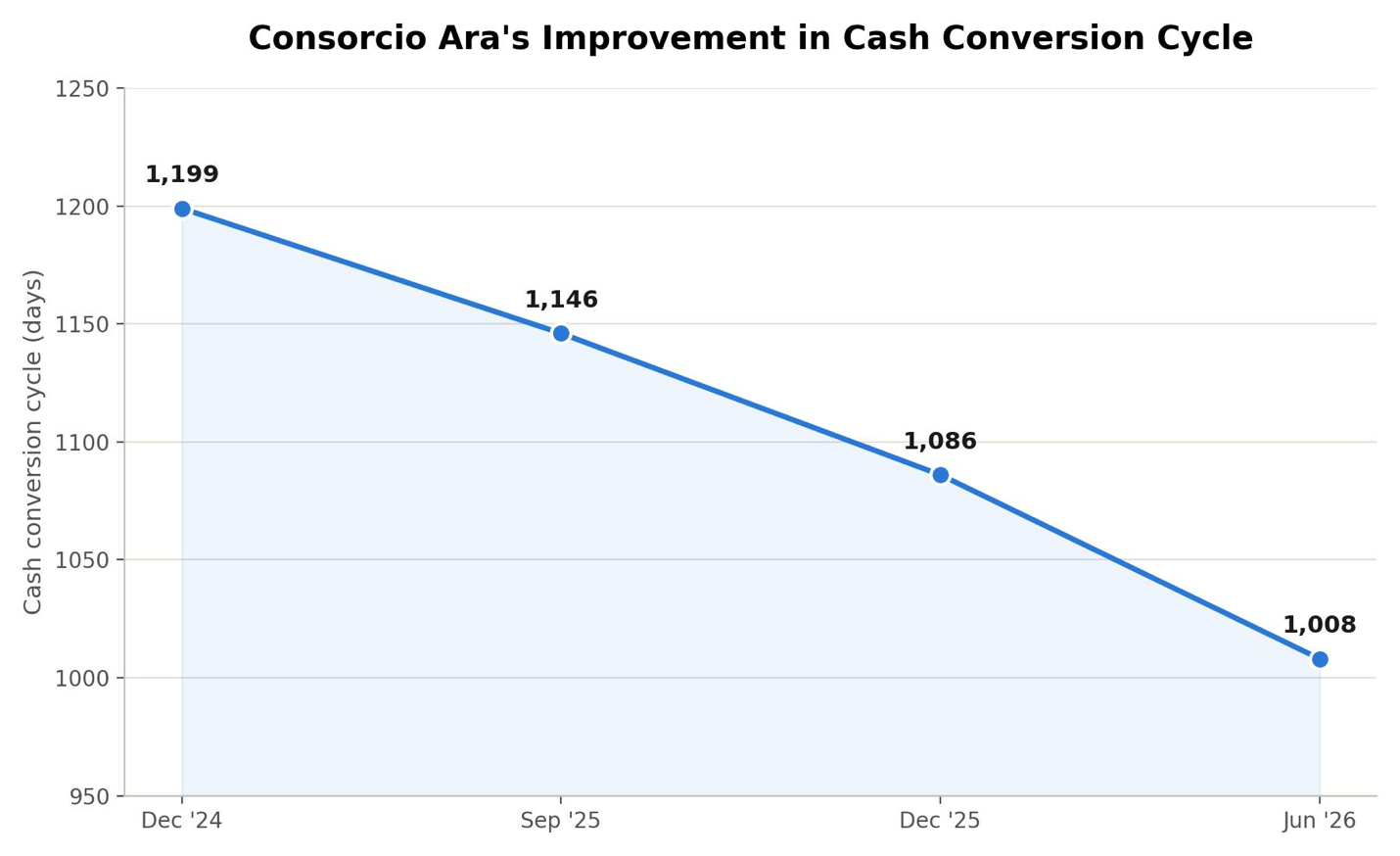
The company just reported its Q2 earnings, and they also announced that free cash flow jumped 45% year over year to approximately MX$379 million of free cash flow for the first half of 2026. And this may be just the beginning, in the next 3+ years, management believes they can drive another 30% reduction, which would unlock about MX$3.8 billion of cash, which would represent almost two-thirds of what the company’s market cap is right now.
Further, ARA announced a first joint venture with another company, in which the partner is providing the land, thus limiting the upfront investment. ARA used to buy all the land it builds on, so this is new for the company. The new management promised that they were now going to focus on capital returns and return on equity and this kind of action is definitive proof that they are delivering on their promise.
The company’s transformation is just starting to take hold, and this is exactly the kind of substantial changes we have been waiting for. Revenue is now growing at a double-digit rate and yet despite a strong first half rally the stock trades at 6.6 times trailing earnings and 37% of book value. We think the stock can go materially higher and are happy to collect dividends and sit back and wait as value is unlocked by management.
Adult-Use Rescheduling Hearing Finishes — What’s Next?
The DEA concluded its two-week rescheduling hearing on July 15th. The DEA judge has given the testifying parties until August 17th to submit follow-up briefs for consideration. We think the rescheduling order will follow closely after that August 17th date, and we expect a decision by the end of September. While anything can happen, we believe adult-use cannabis will be rescheduled just like medicinal cannabis by the DEA and/or the Department of Justice.
We think adult-use rescheduling would have a meaningful and very positive impact on our portfolio companies, which are on the cusp of an inflection. Several of our companies are turning on assets that were funded and built over the last twelve to twenty-four months and are moving from investment mode into revenue and cash-flow mode. Grown Rogue (OTC: GRUSF) began cultivation in Illinois, continues ramping up in New Jersey, and will soon commence operations in Minnesota, which has the highest cannabis prices in the country. LEEF (OTC: LEEEF) continues its expansion of Salisbury Canyon Ranch and just announced the purchase of a processing facility that will allow it to double its output. Vireo (OTC: VREOF) continues its roll-up at a dizzying pace, and we believe it may already be the third-largest cannabis company in the world. Uncle Arnie’s continues to outperform its projections every month.
Adult-use rescheduling should allow more capital to enter the industry, meaning better debt-financing terms, greater access to capital, and, for some of our companies, the potential to list on U.S. stock exchanges.
It’s important to note that simply listing on a U.S. exchange does not automatically mean a company’s valuation will go up. In fact, we’ve seen two U.S. plant-touching companies shift to a New York Stock Exchange listing thanks to medical cannabis being rescheduled, and their stock prices and valuations went down.
We believe that in one of these cases, the company (Trulieve: TRUL) is showing little if any growth and has laid out no specific plan to grow in the future. The other company (Glass House: GLAS) ran sharply higher in anticipation of its NYSE listing and, despite pulling back, still trades north of 20 times 2027 estimates.
What excites us is that we believe we are invested in true growth engines trading at remarkably low valuations. One of our companies is trading at possibly two to three times forward cash-flow estimates. Others are growing at near-triple-digit rates. We continue to believe there is tremendous mispricing within the cannabis industry, because there are very few institutional players and very few people doing real due diligence.
When adult-use rescheduling is finalized, we think sophisticated investors will start to enter the space. The first thing they will focus on is unit-level economics, competitive advantages, and companies that have built growth platforms that can be replicated in new markets. We believe that in a rescheduled world, our companies should soar in value compared to where they trade today.
Uncle Arnie’s Raises an Additional $2 Million
Uncle Arnie’s is simply crushing it.
The company is winning on two fronts: selling low-dose hemp beverages through liquor stores and cannabis beverages through dispensaries. While hemp sales have taken the company to another level, I want to focus your attention on how dispensary sales have taken off since we first invested.
Uncle Arnie’s dispensary sales have tripled since 2023, growing at a 44% CAGR (compound annual growth rate).
The dispensary channel is notoriously difficult, especially for beverages. First, dispensaries aren’t set up for drinks — most have limited refrigeration and limited storage for bulky products. Second, you largely must win dispensary by dispensary; there are few large chains and few, if any, large distributors like those found in the conventional beverage market. Finally, there is broad financial distress and persistent payment challenges across the dispensary market.
This is why Uncle Arnie’s success in dispensaries is so remarkable — and why it matters so much: even if there is no reprieve from the hemp ban by November, Uncle Arnie’s should be able to continue growing quickly in the dispensary channel and expanding into new states.
Regardless of what happens in November, we believe our Uncle Arnie’s investment will be very successful.
Capital is scarce in cannabis, and it’s even scarcer in anything cannabis-related — let alone a category like hemp beverages, which is staring down the barrel of that November ban. So, it’s quite a statement that Uncle Arnie’s was just able to close an oversubscribed $2 million round of fresh capital in a reopening of its Series A financing. The round was led by board member and Boston Beer founding partner Harry Rubin and his partners. Investors should read this as a massive vote of confidence from a beverage-industry veteran who knows the company intimately. Uncle Arnie’s management participated as well, as did the Mindset Uncle Fund. We did not invest additional capital from the Mindset Value Fund.
While there are numerous bills seeking to protect and regulate hemp rather than ban it — and a White House push for a solution — we believe Uncle Arnie’s is well positioned to succeed no matter what happens. Uncle Arnie’s already carries one of the healthiest balance sheets in the industry. This fresh capital, raised with minimal dilution, allows the company to stay aggressive while competitors retreat.
LEEF Doubles Capacity with Processing Acquisition
We invested in LEEF earlier this year to help develop the remainder of Salisbury Canyon Ranch (SCR). The company is making great progress and appears to be under budget and on schedule. At full build-out across its currently permitted 130 acres, SCR should produce approximately 1.3 million pounds of dry biomass at under $8 a pound — enough to yield more than 47 million grams of distillate, or equivalent quantities of live resin and rosin at comparable input costs. LEEF is not standing still at that scale either: it is actively pursuing permits for roughly 100 additional acres beyond the current footprint, which at similar yields would add another 1 million pounds of biomass and 36 million grams of distillate to the pipeline.
LEEF should very shortly be the largest cannabis farm in the world, and it’s on pace to become the largest — and yet lowest-cost — cannabinoid producer in the world as well.
And fresh off the presses, LEEF announced an agreement to acquire and build out a processing facility. This is a bigger deal than it may sound. Under LEEF’s current arrangement, its processing partner takes fifty percent of every harvest as its fee, meaning only about half of the crop grown on SCR is available for LEEF to sell today. Once the processing facility is online in 2027, LEEF will keep the entire harvest. On a 2027 basis, management estimates this move alone should more than double the biomass available to LEEF — from roughly 690,000 pounds to about 1.38 million pounds — and could drive approximately $25 million of incremental revenue and $16 million of incremental EBITDA at the operation level, before accounting for any of the ancillary cost savings the company’s consultant has flagged.
But it’s not the cost and scale that make LEEF so compelling — it’s the fact that LEEF can produce these concentrates free of heavy metals and, most importantly, free of pesticides. Because SCR is surrounded on three sides by mountains and national forest, it doesn’t face the pesticide-drift problem that plagues most cannabis farms in California.
Recalls and reports of pesticide problems in cannabis continue to mount. Regulators in California just issued another recall for Stiizy, the largest vape brand in the state — not the first time pesticides have been found in Stiizy vapes.
I’d also encourage investors to read this Epoch Times article, which follows a sheriff in Siskiyou County, California, on how Chinese pesticides are finding their way into the legal supply chain — and how California isn’t testing for all of them. The same problem is being exposed in Oklahoma and Colorado.
Cannabis can, in many ways, resemble the Wild West. Cannabis brands, retailers, and regulators may not care about long-term pesticide exposure — or may simply be struggling to enforce the rules — but I’ll tell you who must be waiting with bated breath for reform and legalization: class-action lawyers. I believe entire swaths of the cannabis industry are effectively untouchable as investments because of legacy pesticide-contamination issues, and that states like California could find themselves in the crosshairs as well for allowing this to persist.
We think the amount of clean, low-cost biomass and concentrates available is far smaller than most people realize. With adult-use rescheduling, interstate commerce and exports are far closer than before — perhaps even imminent. Once that happens, clean, pesticide-free supply may not be enough to meet demand. Further, when global CPG companies and strategics enter the space, a pesticide-free supply chain will be table stakes.
Ahead of legalization, international export, and eventually interstate commerce, we believe LEEF is fundamentally mispriced, with upside of more than ten times its current enterprise value of approximately $90 million.
Summary
We believe are set up for a very exciting back half of the year. Our portfolio companies are seeing accelerating growth and there is very positive federal reform that should pay big dividends to our cannabis investments as the year unfolds. Thank you so much for your support and trust.
As always, please reach out with any questions or comments.
Sincerely,
Aaron M. Edelheit